trying gentoo
#linux #gentoo
“if gentoo is so good, where’s genthree?”
why…
I decided to pull out some of my spare laptops today and try out some other OSes. genuinely, I do not think i have any other use for that many. initial plan was to have a kind of combination the first on my list was Gentoo! so here we are.
i initially didn’t know much about it other than
- it takes really long to compile everything
- systemD is Optional. which is pretty intriguing, so i tried that out.
installation
I pulled up “gentoo iso” and was greeted w either a graphical or terminal installer. i was an arch lover by heart, so i just decided eh why not. Command Install let’s go
the process itself was fairly straightforward, and very very similar to Arch. hell it even included arch-chroot as one of the steps which i found pretty comical. it was also the first time i was exposed to using Portage / Emerge, the package manager of Gentoo. like duh what was i expecting… but honestly it was pretty useful in letting me know ab some things other managers don’t.
for example:
- I had to figure out that i had to edit package.licenses in /etc/portage to agree to the Linux kernel license. which i thought was automatic, but apparently not. i mean I could just automatically agree to them all, but eh
- i had to Manually Search the timestamp for the stage3 tar file i needed
for reference, I used this gist and not the actual handbook because I got too lazy to read through everything and decide what I needed: https://gist.github.com/andrewward2001/bfe2f296d6486d2d4892c6de5587db1b
am i lazy Yes but at least im doing it myself :D and it worked out in the end. Whatever .
package management
So. emerge. sidenote why is it called emerge when the other name is portage Ok Whatever.
Despite having a kind of a bad rep (to me at least) that “everything has to be compiled”, it really only is if you decide to be a contrarian and set flags that aren’t the default. The defaults are pretty sane (O2) and actually has a binary cache host starting Dec 2023, w/ ‘faster’ x64 being Feb 2024. So yeah, verrrry recent. given that I made my choice for Arch back in 2018 (and went down the suffering rabbit hole).
The syntax for it is relatively simple, but not really.
emerge
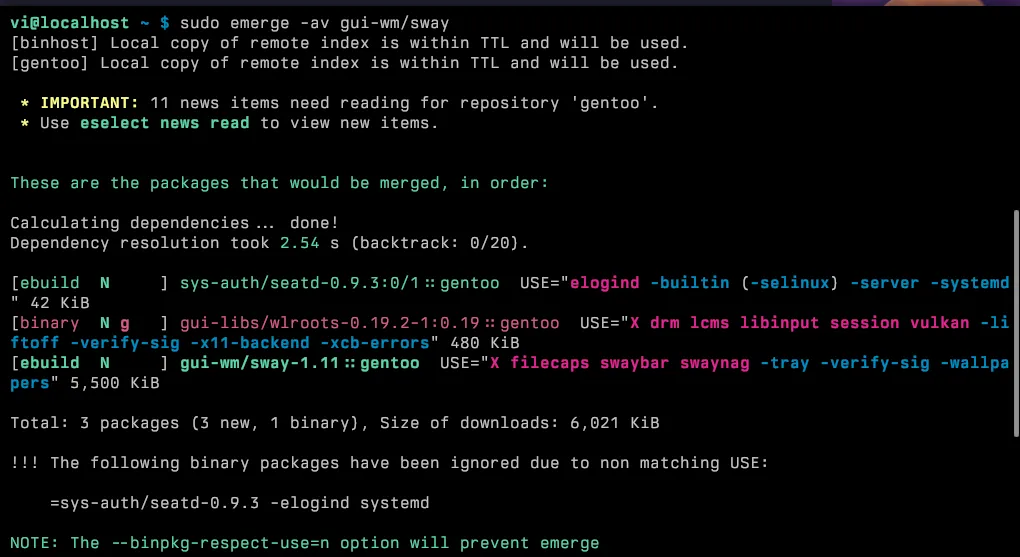
- emerge –ask –verbose (-av) -> install, shows flags that are defaulted.
- for example, here is what happens if i try installing like. sway:
- emerge –sync -> apt autoupdate
- emerge –unmerge xxx -> uninstall
- emerge –depclean -> autoremove
- emerge -uDN -> upgrade, deep, newuse
a useful tool that my Slop Clod told me about was eix. essentially indexes and searches stuff a helluva lot faster than emerge –search does. looks cool!
to set it up, same as any other package, but u gotta sync it w emerge’s database first.
emerge -av app-portage/eixeix-update
USE flags
the main thing that Gentoo has over other packages is its ability to select different features per package, or systemwide.
essentially, you have 2 different things:
- /etc/portage/make.conf which has Global Use Flags. so it passes it to everything and anything that’s installed even if the flag doesn’t exist.
- so stuff like if i really fucking hate X11, i could pass in -x11 in my make.conf.
- or if i wanna live dangerously and compile my whole system w O3, hell yeah!! just change it right there
- here is also where i specify
getbinpkgto make emerge default to binaries if the flags are the same for a package i wanna install.
- /etc/portage/package.use/
/ - in this case, say i wanna add flags
valaandintrospectionto a package that lists it. - in here, i put: package/name vala introspection
- in this case, say i wanna add flags
emerge kinda just figures things out for you without needing u to update it or anything. cool stuff!
GURU (gentoo AUR)
- so I was trying to set up my browser of choice, Helium. picture my surprise when
eix heliumpulled up Absolutely Nothing. atp i was like fuck and figured out that a user repository, GURU, does exist. it’s pretty straightforward to setup:- install
eselect-repositories(what the hell is this iunno either) emerge -av app-eselect/eselect-repositoryeselect repository enable guruemerge --sync guru<- note that i gotta specify the repo now
- install
- one annoying thing I noticed was that most packages in GURU were masked
~amd64, which meant it was in “testing” i suppose. so i had to enable it inpackage.accept_keywordsevery time i wanted to install something after it errored. i wish * worked but alas
gripes
- there’s no easy way to figure out what USE flags are available other than just searching up the package and then equery -u. i mean i guess it’s fine just a little unintuitive.
- build times get a little annoying, but im tempted to use my PC as a host and make it do my evil compilation bidding MWAHHAHAHAHA ahem
- pipewire was / and still is a little bit wonkily supported on OpenRC. like ru seriously telling me i cant enable a service for it and i gotta run
gentoo-pipewire-launcheron sway start? Lmfao ok but anyway it works. bc the wiki page is really detailed: https://wiki.gentoo.org/wiki/PipeWire
anyway that’s concluding my gentoo review. overall i’m still new and haven’t really found a use for USE flags, but there’s a use for it for sure